← Back to the archiveSHORT / 027
Curves & geometryWatch the drawing↗
Can One Equation Weave Butterfly Wings?
BEHIND THE WORK
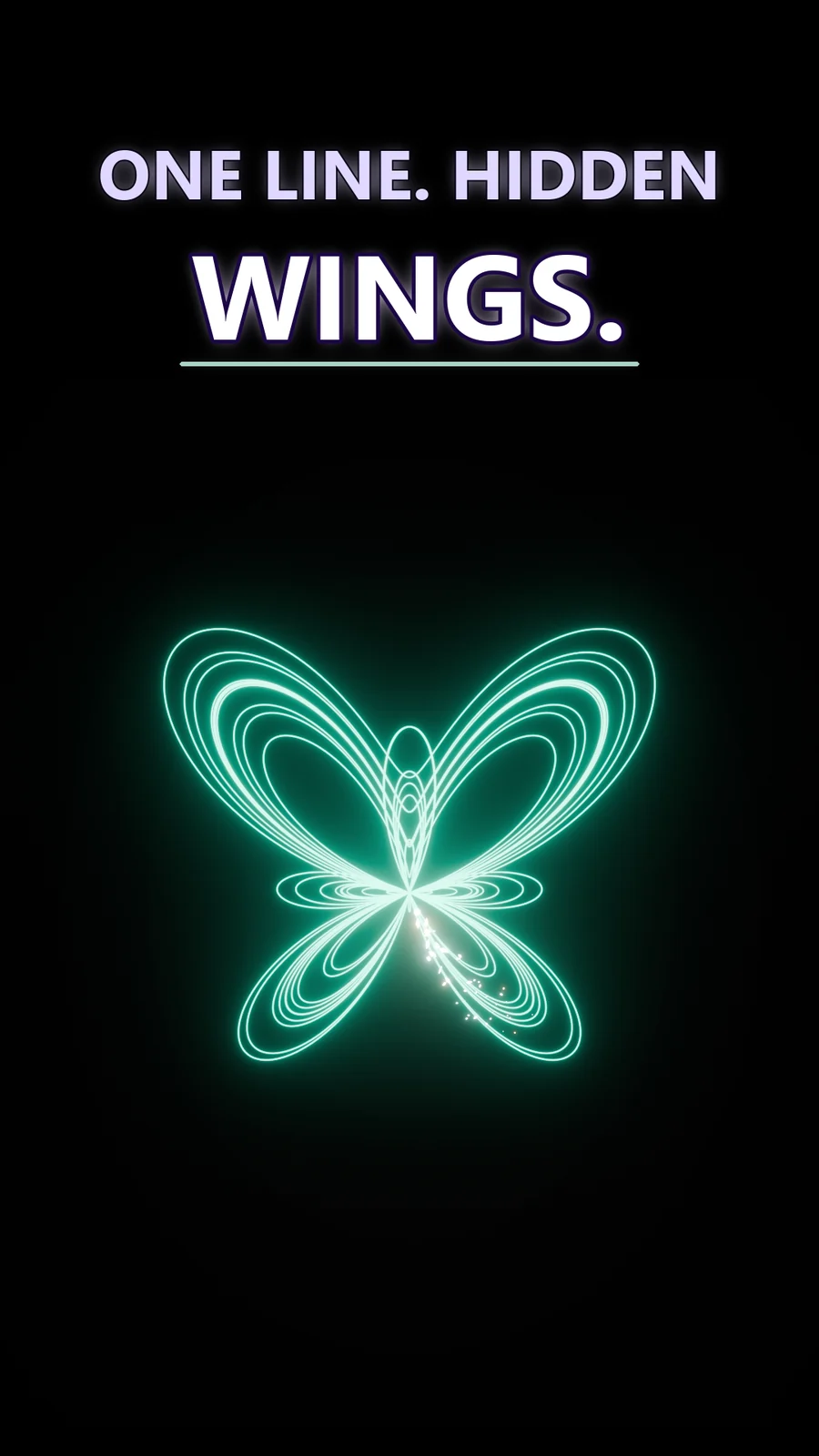
Can one equation weave butterfly wings?
One point follows r(t) = exp(cos t) − 2 cos(4t) + sin⁵(t/12), with x(t) = r(t) sin t and y(t) = r(t) cos t, for 0 ≤ t ≤ 24π. The fast terms shape the wing loops. The slow sin⁵(t/12) term changes successive passes, adding inner and outer layers instead of tracing the same outline. Here exp(u) means e raised to the power u; r is a signed radial factor, so negative values place the point in the opposite direction. The full interval makes twelve parameter turns and closes the path.
This is a planar butterfly curve, not the Lorenz attractor or a simulation of a real butterfly.
Artismathic turns equations into visual art—one function at a time.
Curve reference: https://mathworld.wolfram.com/ButterflyCurve.html Music: 'Eternal Garden' by Dan Henig
#MathArt #GenerativeArt #ButterflyCurve
THE MATHEMATICAL RULE
WATCH IT COME TO LIFE
Watch the drawing
YouTube loads only after you press play.